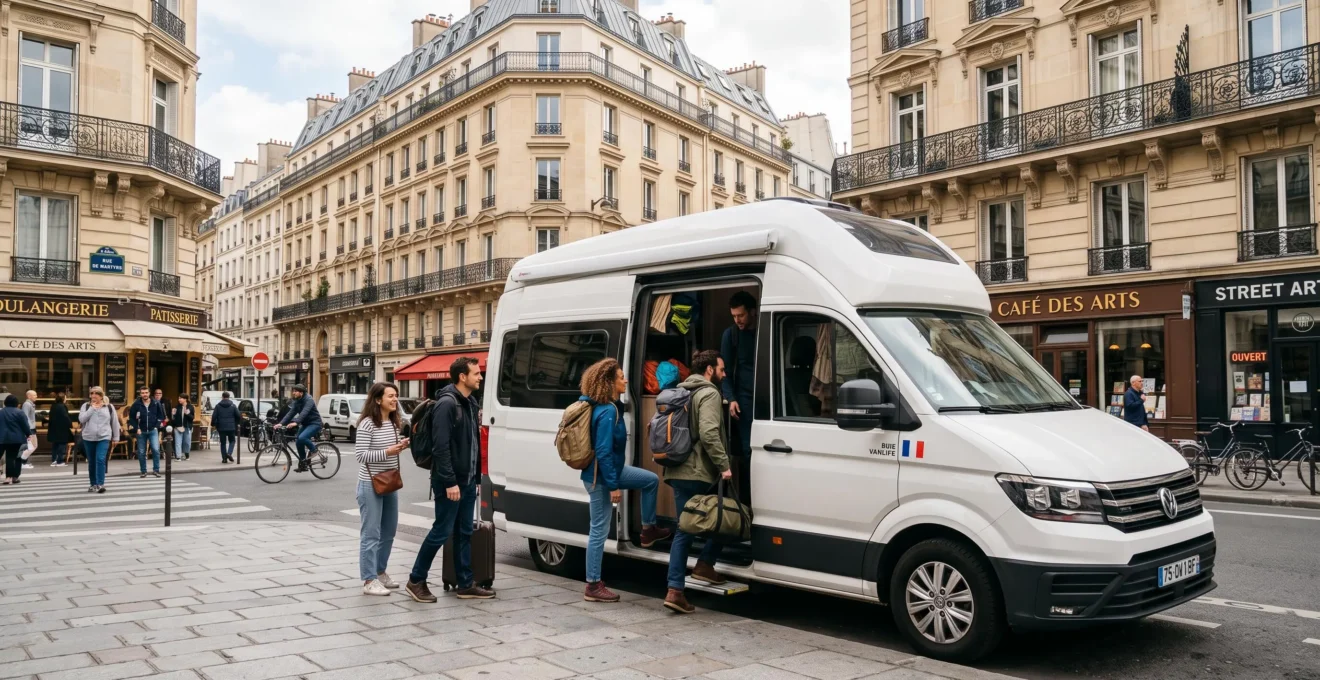
Coordinating transport for a group of six or more visitors arriving in Paris presents an immediate logistical challenge. The default options—splitting across multiple taxis, navigating the métro with luggage, or following fixed-schedule tourist buses—each introduce friction that accumulates throughout a weekend visit. Organisers face a key question: how to maintain group cohesion, manage baggage efficiently, and retain scheduling flexibility without multiplying costs across dozens of journeys?
A campervan might seem an unusual choice for Paris, but it offers a practical solution for group transport. By consolidating 4-8 passengers and their luggage into a single vehicle operated on the group’s schedule, this approach eliminates the coordination overhead inherent in fragmented transport whilst addressing the economic reality of cumulative taxi fares over multiple days. The practicality hinges on accepting basic urban logistics—parking identification, vehicle collection from the airport, driving in dense traffic—in exchange for operational autonomy throughout the visit.
- Why traditional group transport in Paris creates hidden costs
- What makes campervans an unexpected solution for Paris group travel?
- How does campervan group transport compare to other Paris options?
- Key benefits of hiring a campervan for your Paris group
- What to consider when booking a campervan for group transport
- Common questions about campervan group transport in Paris
Why traditional group transport in Paris creates hidden costs
When planning transport for six people across a Paris weekend, the initial calculation often focuses on per-journey unit costs. A single taxi from Charles de Gaulle Airport to central Paris operates within a regulated fare structure, appearing manageable as an isolated expense. The hidden cost emerges through multiplication: a group of six requires two vehicles minimum for each movement, and a typical weekend itinerary involves 10-15 significant journeys—airport transfers, daily site visits, evening restaurant trips, and the potential excursion to Versailles or Fontainebleau.
This multiplication effect transforms seemingly reasonable per-journey costs into a substantial cumulative weekend expenditure. Two taxis or VTC vehicles per movement, repeated across multiple daily trips over three days, generate costs that organisers frequently underestimate when evaluating only the airport transfer or a single journey in isolation. The economic burden extends beyond the monetary total to include booking friction, vehicle availability delays during peak hours, and the coordination overhead of ensuring two vehicles arrive and depart simultaneously at each stop.
Arrival scenario: A group of six arriving at CDG Terminal 2 on Friday at 10:00 with standard weekend luggage faces an immediate choice: book two taxis capable of carrying three passengers plus baggage each, or navigate the RER B line with six people, six cabin bags, and four checked suitcases through crowded carriages and station transfers.
The RATP public transport network presents a different cost structure but introduces operational complexity for groups managing luggage. While individual ticket costs remain modest, the practical challenges of maintaining group cohesion across platform changes, managing baggage through turnstiles and escalators, and coordinating movements on crowded trains during peak periods create non-monetary costs. Groups inevitably fragment across carriages during busy periods, requiring constant communication and regrouping at each stop. The Navigo monthly pass, priced at €90.80 according to official French government guidance (January 2026 rate), offers unlimited travel but proves cost-ineffective for short weekend visits requiring only zones 1-5 coverage.
Fixed-schedule hop-on hop-off tours in Paris eliminate driving and parking concerns but impose rigid timing constraints incompatible with personalised itineraries. Routes follow predetermined circuits focused on central monuments, offering limited flexibility for exploring residential arrondissements, accessing specific restaurants at chosen times, or extending visits beyond the operational hours of tour services. For groups seeking spontaneity—deciding mid-afternoon to visit Versailles, or extending a museum visit beyond the originally planned duration—fixed-route tourist transport becomes a limiting rather than enabling infrastructure.
The invisible costs accumulating across these traditional options include organisational time spent coordinating movements, stress managing group separation and reunion logistics, lost convivial moments during fragmented metro journeys where conversation proves impossible, and the mental load of constant micromanagement throughout the weekend. These non-monetary costs rarely appear in initial budget calculations but directly impact the quality of the group experience and the organiser’s capacity to participate rather than perpetually coordinate.
What makes campervans an unexpected solution for Paris group travel?
Direct answer: Standard rental campervans measure approximately 6-7 metres in length and 2-2.2 metres in width, comparable to commercial vans like the Renault Master or Ford Transit that navigate Parisian streets daily for deliveries. The vehicle category designed for motorway road trips functions equally as mobile group transport when repurposed for urban logistics.
The primary psychological barrier to considering a campervan for Paris transport stems from the mental association between vehicle type and intended usage context. Campervans occupy the conceptual category of recreational vehicles for countryside touring and overnight accommodation, not urban group mobility. This categorisation obscures their fundamental characteristics: a large passenger capacity (typically 4-9 seats with safety belts), substantial luggage storage, and dimensions that, whilst larger than a standard car, remain within the operational envelope of commercial vehicles routinely circulating in Paris.
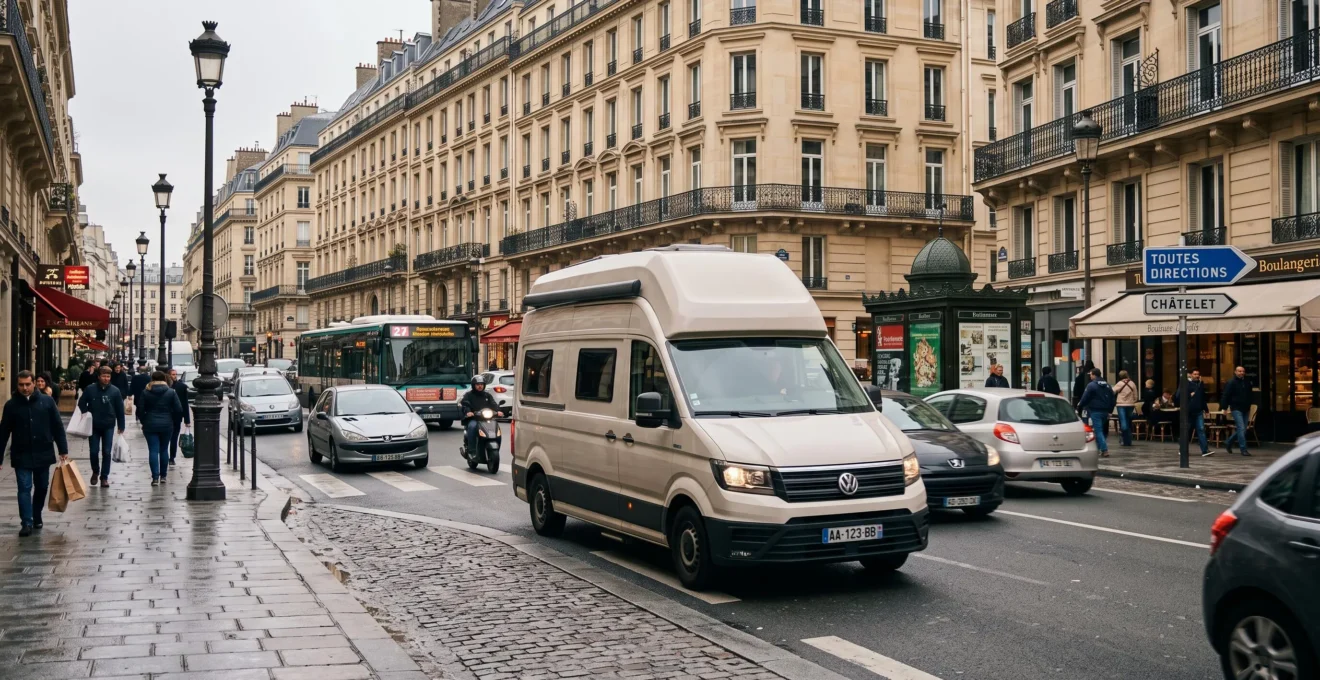
Reframing the vehicle category proves essential: consider a campervan not as accommodation-on-wheels but as a private minibus that happens to include internal amenities. This conceptual shift aligns the evaluation criteria with the actual use case—moving 6-8 people and luggage across Paris and surrounding Île-de-France region—rather than assessing it against irrelevant recreational vehicle standards. The sleeping facilities and kitchen equipment remain unused during day-trip urban deployment, but the seating capacity and cargo space function as the core transport infrastructure.
The main advantage is keeping the entire group together. Unlike multiple taxis that must be separately booked, tracked, and coordinated at each departure and arrival point, a single vehicle eliminates the fragmentation inherent in split-group transport. The entire party travels together, departs when ready without waiting for vehicle availability, and arrives simultaneously without regrouping logistics. This consolidation removes an entire category of coordination overhead from the organiser’s responsibilities.
Parking dimensions require acknowledgment rather than avoidance. A campervan’s height (typically 2.5-3 metres) restricts access to some underground car parks with low ceiling clearances, but does not prevent Paris parking entirely. Public car parks operated by Saemes, Indigo, and municipal authorities maintain facilities with height clearances exceeding 3 metres, identifiable through online booking platforms with vehicle specification filters. Street parking follows standard regulations, with the vehicle width remaining within legal bay dimensions despite the extended length requiring attention to zone restrictions and resident-permit areas.
Vehicle pickup from Charles de Gaulle Airport addresses the practical start-point for groups arriving by plane. Rental providers offering campervan hire at Roissy provide airport-proximate collection, eliminating the need for separate transfers into central Paris before accessing the vehicle. This logistical alignment means baggage loads directly from airport trolley to vehicle storage, with the group immediately mobile toward their accommodation or first destination without intermediate transport stages.
How does campervan group transport compare to other Paris options?
Evaluating transport options for a six-person group across a Friday-to-Sunday Paris weekend requires accounting for all cost components, not merely the most visible headline prices. A comprehensive comparison must include vehicle rental or per-journey fares, fuel consumption, parking fees where applicable, access tolls for regional excursions, and public transport tickets across all passengers and journeys. The variables influencing final costs—exact group size, number of movements, inclusion of destinations beyond central Paris—demand explicit identification to enable readers to adjust calculations to their specific circumstances.
The following framework illustrates the cost structure for a representative weekend scenario: six people arriving CDG Friday morning, departing Sunday evening, with daily Paris movements and one full-day Versailles excursion. Actual costs fluctuate based on season, specific vehicle models, fuel price variations, and parking location choices, but the structural cost categories remain consistent.
| Cost component | Multiple taxis/VTC | Public transport | Campervan hire |
|---|---|---|---|
| Base transport cost | Per-journey fares × 2 vehicles × ~10 trips | Individual tickets or 3-day passes × 6 people | 3-day weekend rental fee |
| Fuel | Included in taxi fares | Not applicable | ~200km at vehicle consumption rate |
| Parking | Not applicable | Not applicable | 2-3 days public car park or hotel arrangement |
| Coordination overhead | Booking 20+ individual journeys, vehicle availability delays | Constant group management across platforms and transfers | Single vehicle collection and return |
| Flexibility | Dependent on vehicle availability and surge pricing | Fixed to public transport schedules and routes | Complete schedule autonomy |
| Baggage handling | Divided across vehicles, repeated loading/unloading | Carried through all transfers and platform changes | Single load at CDG, secured in vehicle during visits |
Example cost comparison for a typical weekend (6 people, Friday–Sunday): Multiple taxis could total €400–600, public transport €120–180 (6 people × €20–30 for 3-day passes), and campervan rental €250–400 plus fuel (€30–40) and parking (€60–90). Total campervan cost: approximately €340–530.
The economic advantage of consolidated transport amplifies with group size and journey frequency. A group of four making limited movements might find the rental overhead unjustified, whilst eight people undertaking daily excursions beyond central Paris see the per-person daily cost decrease substantially. The threshold where campervan economics become favourable typically emerges around 6-7 people maintaining active daily itineraries across 3+ days, particularly when regional destinations like Versailles, Fontainebleau, or Giverny feature in the programme.
- Friday 10:00 – CDG to accommodationSix passengers plus luggage require two taxis or challenging RER journey with multiple bag-carrying stages. Campervan: direct loading and single journey to accommodation with immediate vehicle availability.
- Friday 14:00 – Accommodation to MontmartreGroup coordination: two taxis booked or métro requiring line changes. Campervan: departure at group’s chosen moment, direct parking vicinity Sacré-Cœur.
- Friday 20:00 – Montmartre to Marais restaurantEvening availability challenges for multiple taxis during peak demand. Public transport viable but time-consuming. Campervan: immediate departure, timed arrival.
- Saturday full day – Versailles excursionRER C to Versailles viable but crowded weekends. Multiple taxis prohibitively expensive for 25km journey. Campervan: direct access, flexible departure and return timing, parking at Versailles facilities.
- Sunday 09:00 – Accommodation to LouvreSunday morning transport availability varies. Campervan maintains consistent availability regardless of day or hour.
- Sunday 16:00 – Final Paris visit to CDG departureAirport transfer with luggage previously stored at accommodation. Taxis require retrieval logistics. Campervan: bags already loaded, direct final journey.
The qualitative comparison extends beyond monetary costs to encompass journey experience factors. Taxis offer door-to-door convenience but fragment the group and introduce waiting periods. Public transport minimises per-person cost but maximises coordination effort and eliminates private conversation space. Campervans trade parking logistics and driving responsibility for complete group consolidation and schedule flexibility. The optimal choice depends on which trade-offs align with group priorities: minimum organiser effort, lowest monetary cost, maximum spontaneity, or sustained group cohesion.

Key benefits of hiring a campervan for your Paris group
The operational advantages of consolidated group transport extend beyond cost arithmetic into qualitative experience factors that prove difficult to quantify but directly impact weekend satisfaction. Maintaining physical group cohesion throughout all journeys preserves the social continuity that represents the primary purpose of group travel. Rather than splitting conversations across separate vehicles or metro carriages where communication becomes impossible, the entire party shares journey time as an extension of the visit experience.
This sustained proximity proves particularly valuable during longer journeys such as the 45-minute return from Versailles, transforming transit time from operational necessity into social opportunity. Groups discuss the day’s experiences, plan evening activities, and maintain the convivial atmosphere that fragmented transport interrupts. The organiser participates in these moments rather than coordinating separate vehicle arrivals or counting heads at platform exits.
Baggage management simplification eliminates a persistent operational friction throughout the weekend. Upon CDG arrival, luggage loads once into the vehicle’s storage area and remains secured during all subsequent visits to museums, restaurants, and sites. The alternative—carrying bags through public transport, storing them at accommodation requiring mid-day returns, or dividing them across multiple taxis with repeated loading and unloading—introduces cumulative hassle that campervan storage removes entirely. Personal items, purchases, and equipment remain accessible but secure without constant carrying or supervision.

Access to Île-de-France destinations beyond the central arrondissements expands itinerary possibilities without the constraint of train schedules or the expense of extended taxi journeys. Versailles, Fontainebleau, Giverny, and other regional sites become feasible same-day excursions with departure and return timing determined by the group’s preference rather than SNCF timetables. This flexibility proves valuable when weather changes prompt itinerary adjustments, or when a museum visit extends beyond the initially planned duration without creating knock-on coordination problems.
Complete scheduling autonomy removes time-of-day constraints that public transport and taxi availability impose. Groups that prefer late morning starts, extended restaurant evenings beyond final métro services, or spontaneous mid-itinerary changes operate without reference to external timetables or vehicle availability. The last RER departure, peak-hour taxi surge pricing, and hop-on hop-off bus operating hours cease to function as scheduling boundaries.
Balanced assessment: advantages and constraints
- Entire group travels together maintaining social cohesion
- Single baggage load at airport, secured storage throughout visit
- Complete schedule flexibility independent of external timetables
- Regional destinations accessible without train dependencies
- Private conversation space during journeys
- Per-person cost decreases as group size increases
- Parking requires identification of height-compatible facilities
- Driving in dense Paris traffic demands attention and confidence
- Vehicle dimensions necessitate awareness in narrow streets
- One designated driver bears responsibility (though sharing possible with multiple licence holders)
- Fuel and parking costs supplement rental fee
What to consider when booking a campervan for group transport
Translating conceptual interest into operational reality requires addressing specific booking criteria and logistical details before committing to a reservation. The first verification concerns passenger capacity alignment with actual group size. Campervans display legal seating capacity based on installed safety-belted seats, typically ranging from 4 to 9 positions depending on model and conversion specification. Exceeding this homologated capacity, even for short urban journeys, invalidates insurance coverage and violates passenger safety regulations. Confirm the specific vehicle’s certificated seating count matches or exceeds your group size.
Driving licence requirements constitute a frequent concern requiring clarification. According to official French parliamentary guidance on vehicle licensing, the determining factor is the vehicle’s PTAC (Poids Total Autorisé en Charge—maximum authorised laden weight). Standard category B driving licences (UK or EU) permit operation of vehicles up to 3,500 kg PTAC, which encompasses the majority of rental campervans. Verify the specific model’s PTAC before booking; most 6-7 berth campervans remain below this threshold, but larger motorhomes may exceed it, requiring category C licensing.
CDG vehicle collection logistics: Airport-based rental providers offer various pickup arrangements. Some maintain on-site facilities at Roissy requiring a short shuttle transfer from terminals. Others provide meet-and-greet services at arrival halls with vehicle handover in designated parking areas. Clarify the exact collection procedure, required timing margin after landing, and whether the provider operates from CDG directly or requires transfer to an off-airport depot, which introduces additional logistics.
Parking strategy development proves essential before arrival. Whilst street parking remains possible within standard regulations, identifying height-compatible public car parks near your accommodation or primary sites eliminates daily parking uncertainty. The Saemes and Indigo networks operate facilities throughout Paris with online booking systems featuring vehicle specification filters. Entering height parameters (typically 2.5-3 metres for campervans) identifies suitable facilities, allowing advance reservation during peak periods. Alternative approaches include peripheral parking with final-leg public transport for visiting congested central zones, or negotiating hotel parking access if available.
Insurance coverage and excess liability warrant examination during booking. Standard rental agreements include basic third-party coverage, but damage excess amounts—the sum for which the hirer remains liable before insurance covers claims—vary significantly between providers. Optional excess reduction packages decrease personal liability exposure but add daily costs. Height-related damage from low barriers or overhanging branches represents a specific risk category; verify whether the policy covers such incidents and under what conditions.
- Confirm vehicle seating capacity equals or exceeds group size
- Verify PTAC remains below 3,500 kg for standard B licence operation
- Clarify CDG pickup procedure, timing, and exact collection location
- Identify height-compatible parking facilities near accommodation and key destinations
- Review insurance excess amounts and available reduction options
- Confirm fuel policy (full-to-full, pre-purchase, or other arrangement)
- Check mileage allowance and excess kilometre charges if applicable
- Verify minimum hire period accommodates your weekend duration
Fuel policy typically operates on a full-to-full basis: collect the vehicle with a full tank, return it full, avoiding refuelling charges. Confirm this arrangement and locate fuel stations convenient to your CDG return route. Some providers offer pre-purchase fuel options or charge for refuelling services; understand these costs before accepting.
Minimum rental periods vary between providers, with some requiring 3-7 day minimums whilst others accommodate shorter weekend bookings. Weekend Friday-to-Sunday rentals often prove available during high season but may face minimum-period restrictions during quieter months. Verify your intended dates fall within acceptable booking parameters for your chosen provider.
Common questions about campervan group transport in Paris
Do I need a special driving licence to operate a campervan in France?
A standard UK or EU category B driving licence suffices for campervans with a PTAC (maximum authorised laden weight) below 3,500 kg, which includes most rental models. Verify the specific vehicle’s PTAC specification during booking, as larger motorhomes exceeding this threshold require category C licensing. The PTAC figure appears on the vehicle’s registration certificate and rental documentation.
Where can I park a campervan in central Paris?
Public car parks include facilities with height clearances exceeding 3 metres, some of which can be booked online using vehicle specification filters. Street parking follows standard regulations, with the vehicle required to fit within legal bay dimensions while also respecting length and zone restrictions. Peripheral parking combined with public transport for the final part of the journey can be a practical alternative when visiting highly congested areas. Height-restriction barriers may be subject to specific local regulations, while individual car park operators set their own access policies.
Are there motorway tolls for travelling to Versailles or other regional destinations?
The Paris périphérique ring road remains toll-free. Routes to Versailles may include toll sections depending on the specific itinerary chosen, typically involving modest charges for regional autoroute access. Non-toll alternative routes exist via departmental roads but extend journey time. Check your planned route using navigation tools that display toll locations and costs before departure.
Can I return the campervan to a different location from pickup?
One-way rentals between different provider locations often prove available but typically incur additional repositioning fees that can substantially increase total costs. Verify availability and associated charges with your chosen provider before booking if one-way rental suits your itinerary. Same-location return generally offers better economic value for Paris-based weekends.
Is driving a campervan in Paris traffic difficult for inexperienced drivers?
Vehicle dimensions match commercial vans like the Renault Master or Ford Transit, but height requires attention to overhead clearances including car park entrances, tree branches, and tunnel restrictions. Dense Paris traffic demands awareness and confidence, though speeds remain moderate. Familiarisation in peripheral areas before entering central arrondissements helps drivers adapt to the vehicle’s size. Visibility from the elevated driving position actually exceeds that of standard cars, and modern campervans include parking sensors and reversing cameras as standard or optional equipment.
What is the minimum rental period for campervans?
Minimum hire periods vary between providers, typically ranging from 3 to 7 days depending on season and availability. Weekend 2-3 night rentals often become available during high season when providers adjust minimum periods to accommodate short-break demand. Verify specific minimum duration requirements with your chosen provider for your intended travel dates.
For groups of 6-8 people maintaining active itineraries across Paris and the Île-de-France region, the campervan transport model transforms structural logistics challenges into managed operational details. The economic case strengthens with group size and journey frequency, whilst the qualitative advantages—sustained group cohesion, simplified baggage management, schedule autonomy—remain constant regardless of cost comparisons. The decision hinges on accepting responsibility for parking identification and urban driving in exchange for eliminating the coordination overhead inherent in fragmented transport systems.
Groups prioritising minimum organiser effort, maximum flexibility, and continuous social interaction find these benefits outweigh the parking and driving constraints. Those preferring to delegate transport entirely to professional drivers, or operating with highly predictable fixed schedules, may find traditional taxi or scheduled transport better aligned with their preferences. The framework outlined throughout this analysis enables objective evaluation based on explicit cost components, transparent trade-offs, and concrete scenario planning rather than assumptions about vehicle category suitability. For those ready to explore this transport approach further, our comprehensive guide to travel by van provides detailed operational guidance beyond the urban group context examined here.